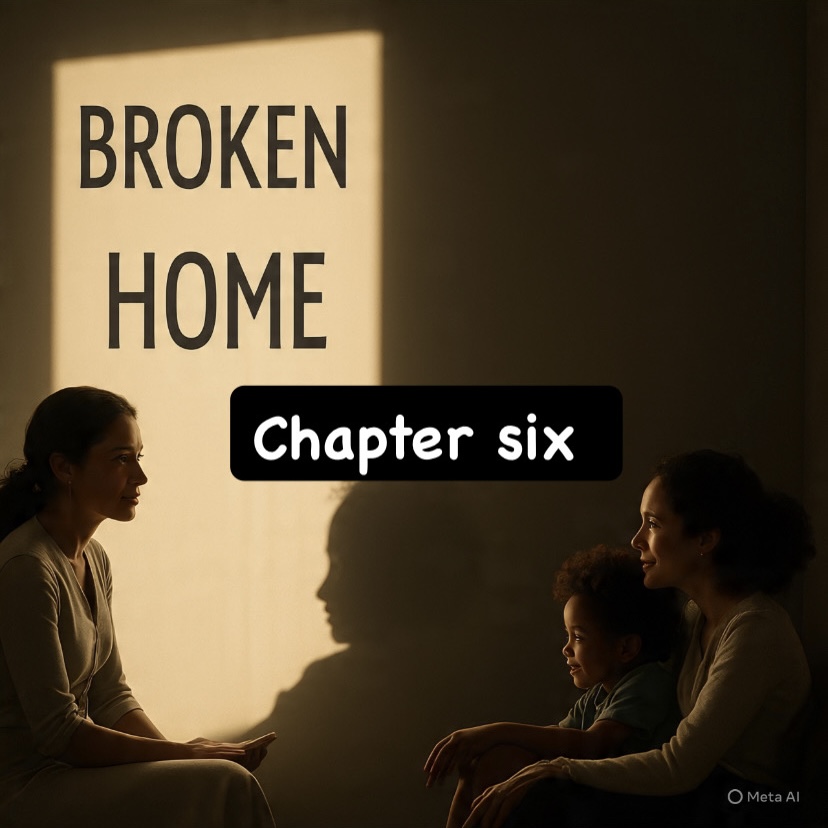
Chapter six
After her confession, the room felt heavier than it had ever been in my life. I stood there, still trying to process everything she had said, still trying to understand what was real, what was emotion, and what was just the fear of someone who knew their time was ending.
She was still crying softly at first, her voice weak and broken. Her children were outside, and the house was unusually quiet, almost as if even the walls were waiting for what was going to happen next. I didn’t know what to say to her. A part of me was still holding onto everything that had happened between us over the years, while another part of me was beginning to feel something softer—something closer to pity than anger.
She kept repeating her apology.
She kept asking for forgiveness.
And then she spoke again, this time more urgently, almost like she was trying to finish saying everything before it was too late. She mentioned a malam in Borno again, insisting that if I ever wanted clarity or answers, I should try to contact him. Her words were not clear or strong anymore; they were scattered, broken, and filled with fear.
I didn’t respond to that part.
I couldn’t.
Because deep inside me, I was already overwhelmed by everything happening in front of me. I wasn’t thinking about revenge or explanations anymore. I was just looking at a human being who was suffering, someone I had once seen as a rival, now lying weak and fading in front of me.
Her condition worsened quickly after that moment.
It was as if once she said everything she had been holding inside, her strength completely left her body. She began to struggle more, her breathing becoming irregular, her voice fading in and out. The relatives were called back into the room. The children stood at a distance, confused and scared, watching their mother in a way no child should ever have to.
The atmosphere turned chaotic.
People were moving around, calling for help, trying to support her, trying to calm her. But nothing seemed to work. She was slipping away slowly, her energy disappearing bit by bit.
There were moments she would scream softly, not out of anger, but out of pain and fear. It wasn’t loud or dramatic in the way people imagine—it was heartbreaking. The sound of someone who knew they were leaving this world and could not stop it.
I stood there, frozen in place, watching everything unfold.
At some point, I had to step back because I couldn’t hold myself together anymore. My emotions were too mixed—shock, sadness, confusion, and something I couldn’t even name. I never expected it to end like this. Not after everything between us.
And then, later that night, the news came.
She had passed away.
Just like that.
The house that had been filled with noise and movement suddenly became silent again, but this time, it was a different kind of silence. A final silence.
I sat alone for a long time after hearing it, unable to fully process it. Everything that had happened between us replayed in my mind—the arguments, the tension, the confession, her tears, her final words.
And in that moment, something inside me changed.
I let go.
I forgave her.
Not because everything suddenly made sense, but because holding onto pain any longer felt heavier than I could carry. She was gone, and whatever truth she carried with her left with her too.
All I was left with was silence… and memories.
After her death, everything in the house changed again, but this time in a quieter, more settled way. The tension that once filled every corner was gone, replaced by silence and reflection. I never thought I would feel that kind of calm after everything we had been through, but somehow, life had moved into a different phase.
Her children stayed.
And something unexpected happened between us.
I didn’t reject them. I didn’t treat them differently. From the very beginning, I saw them as children who had just lost their mother, not as symbols of anything else. Maybe it was because I had gone through so much myself, or maybe it was just something inside me that refused to let innocent children carry the weight of adult conflicts.
Slowly, they began to come closer to me.
At first, it was small things—sitting near me, asking simple questions, following me around the house. Then it became more natural. They would call me, talk to me, and look for me when they needed comfort. Without even planning it, I became a kind of mother figure to them.
I never forced it.
It just happened.
And I accepted it.
I gave them attention, care, and patience. I made sure they ate well, studied, and felt safe in the house. I never reminded them of anything that had happened between me and their mother. To me, they were just children trying to adjust to a life without her.
Over time, the bond became stronger.
They started calling me for everything. They would sit with me in the evenings, talk about their day, and even joke around like nothing heavy had ever happened in the house. In their eyes, I was no longer just “the other wife.” I had become their mother in every way that mattered to them.
And I accepted that role fully.
Not out of obligation, but out of something deeper—maybe compassion, maybe healing, or maybe just the way life naturally rearranges itself when people survive too much pain.
During this period, my husband and I had a rare moment of agreement. We decided to travel to Borno together. There was still something lingering in our minds about everything that had been said before her death, especially the mention of the malam she spoke about in her final moments.
It wasn’t an easy decision, but we both felt the need for closure.
So we went.
When we arrived in Borno, we asked questions, followed leads, and tried to locate the man she had mentioned. It wasn’t a simple search. People gave different answers, different directions, and different stories. It felt like chasing something that kept slipping away every time we got close.
And then we heard the news.
The malam had passed away some months earlier.
Just like that, the last possible link to the answers we were searching for was gone. There was nothing more to find, nothing more to ask, nothing more to confirm.
We stood there in silence, both of us realizing that whatever truth we thought we were chasing had also disappeared.
We eventually returned home without answers.
Life continued, but in a different tone now—quieter, more reflective, less focused on questions that might never be answered.
As for Lamin… my son…
Nothing truly changed in the way I had hoped it would.
His struggles remained part of our lives, something I had to continue managing and praying about. There were moments of hope, moments of setback, and moments where I simply had to accept that healing is not always immediate or complete.
And deep down, I began to understand something very important.
Not everything in life has a clear explanation.
Not everything gets resolved the way we want.
Some things… just become part of our story.
And Lamin’s journey, in all its pain and difficulty, became something I had to carry with me—not with blame, but with acceptance, strength, and the hope that even broken paths can still lead somewhere meaningful in time.
After everything that happened, I had to accept a painful truth I never imagined I would face in my life. My son Lamin, the child I once had so much hope for, never fully recovered. No matter how many treatments we tried, no matter how many times we went back and forth between hospitals and rehabilitation, something about him remained broken in a way I could not fix.
It hurt me deeply, but over time I stopped fighting reality and started learning how to live with it.
In the end, I had no other children except the two girls who once belonged to Ammie. They had become my responsibility, my comfort, and in many ways, my reason to keep going. Life has a way of rearranging itself in ways you never expect, and somehow, I found myself fully stepping into the role of their mother.
I cared for them as if they were my own.
I didn’t differentiate between them and any child I could have given birth to myself. I made sure they had everything they needed—love, attention, discipline, and especially education. I enrolled them in some of the best schools in Abuja, making sure they had opportunities I once wished for others in my life.
They grew up with stability, and I grew with them.
God knows what was in my heart during all those years. I carried pain, yes, but I also carried responsibility. I had learned by then that life is not always about what you lose, but about how you handle what remains. So I focused on what remained.
My husband was still alive at that point, though things had become quieter between us over time. We were no longer the same couple we used to be in the early years of our marriage. Life, responsibility, loss, and time had changed the way we related to each other. We coexisted more than we truly lived together emotionally.
But I continued my life with patience.
I took care of the home, the children, and myself in the only way I knew how. There were no more fights, no more co-wife tension, no more competition. Everything had settled into a strange kind of calm.
Then, after about three years, another major change came.
My husband passed away.
It was sudden in the way that death often is—final, unquestionable, and irreversible. One moment he was part of my life, and the next, he was gone completely. The man I once shared my home with, the father of my child, the one who had once been the center of my world in different ways, was no longer there.
Just like that, I was alone.
Completely alone in a way I had never experienced before.
But life didn’t stop.
It continued.
And in that continuation, I discovered something I had never really understood before—responsibility without support, leadership without partnership, and survival without emotional balance.
I was left with the children.
And I was left with wealth.
A large inheritance, millions, property, and resources I never imagined I would be managing alone. On paper, it looked like stability. To the outside world, it might even have looked like success. But inside, it felt very different.
Because money does not replace people.
And wealth does not replace family.
Still, I had to move forward.
I had to raise the children, guide them, and protect what was left of everything we had built. I had to become both father and mother in a way I never planned for.
Some days were easier than others.
Some days were quiet but heavy.
And some days, I would sit alone and reflect on everything—my marriage, my co-wife, my son, the losses, the lessons, and the strange way life had unfolded for me.
But through it all, I kept going.
Because even when life takes everything you expected… it still leaves you with something to continue with.
Ten years later, life had taken another full turn in a way I could never have predicted when everything first began to fall apart. Time has a way of healing wounds quietly, without asking for permission, and in those years, I had slowly learned how to live again—not the way I once planned, but in a way that felt more peaceful and stable.
The two girls I raised as my own had grown into beautiful, intelligent young women. Watching them grow was one of the few things that kept me grounded through all those years. They were no longer children depending on me for everything; they had become strong, focused, and determined women with their own dreams and direction.
And eventually, life brought them both into marriage.
The first one got married to a banker based in London. It was a simple but meaningful union, the kind that reflected the calm and discipline she had grown up with. She had always been the more reserved one, careful with her words and actions, and somehow it felt fitting that her life took her far away, into a structured and stable environment abroad.
The second one got married to a senator.
Her journey was different. She was more outspoken, more confident, more socially aware. She carried herself with a kind of presence that naturally drew attention. Her marriage reflected that part of her personality—connected to influence, leadership, and public life. It was a different world, but one she seemed prepared for in her own way.
As I watched them both move into their new lives, I felt something deep inside me that I hadn’t felt in a long time—peace.
Not the kind of peace that comes from forgetting the past, but the kind that comes from accepting it.
They didn’t forget me.
Even after marriage, they stayed close. They called me often, visited when they could, and made sure I was never truly alone. The love we built over the years didn’t disappear with time or distance. Instead, it matured into something stronger—respect, gratitude, and responsibility.
And slowly, I began to experience something I had long stopped expecting.
Care.
They started taking care of me in ways that felt natural to them. Financially, emotionally, and physically, they made sure I was comfortable. Not because I asked, but because they wanted to. They would send support, check on me, and ensure I lacked nothing in my daily life.
It humbled me deeply.
Because I remembered where everything started—from confusion, struggle, rivalry, loss, and emotional pain. And now, I was sitting in a completely different phase of life, being cared for by the same children I once raised through chaos.
It made me reflect on everything.
On marriage.
On motherhood.
On pain.
On time.
Life had taught me lessons I never expected to learn. That control is temporary. That pride fades. That people come and go. And that sometimes, what looks like the end of your story is only a transition into something you don’t yet understand.
I realized that every phase of my life—no matter how painful—had shaped the outcome I was living today.
And in my quiet moments, I understood something clearly.
I didn’t end up where I planned.
But I ended up somewhere I could finally breathe.
That’s the End of my story